What we check before any offer
Buying a Used Yacht in the Gulf: The Pre-Purchase Survey Checklist
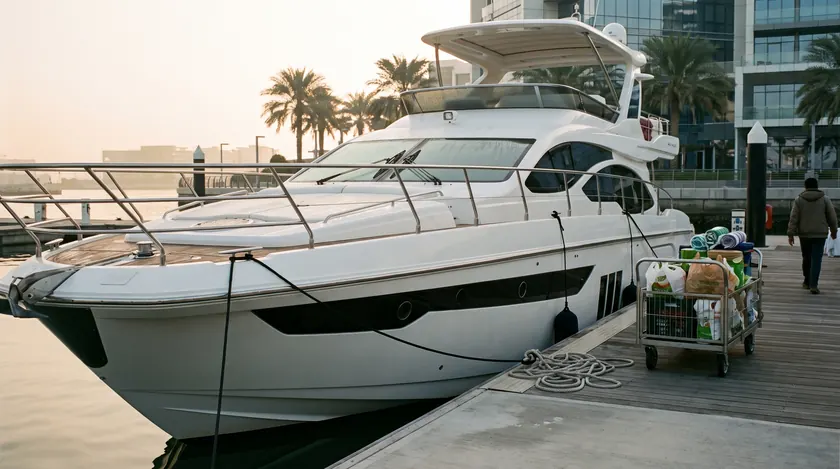
Every used-yacht file we open in the Gulf ends up with the same line near the top, regardless of builder: check for osmosis below the waterline. That single item appears on the buying-checks list for every model we track, from a production Azimut 68 to a flagship Riva 88 Folgore, and it tells you something real about what warm Gulf water does to a hull over time.
This is the checklist we actually walk a used-yacht buyer through before an offer goes in, built from the specific checks we flag model by model, not a generic template.
What does a marine surveyor check during a pre-purchase survey?
A full pre-purchase survey covers the hull, the structure, the mechanical systems and the paperwork behind all three. In warm, high-UV Gulf conditions, a few of those areas carry more weight than they might in a cooler market.
| System | What is checked | Why it matters in the Gulf |
|---|---|---|
| Hull | Osmosis and blister survey below the waterline | Named as a check on every model we track; warm water accelerates the process |
| Structure | Stringers, transom and structural bulkhead condition | Flagged specifically on older hulls such as 1999 to 2008 Azimut 68 builds |
| Engines and drivetrain | Hours, service history, pod-drive seals or shaft alignment | IPS pod-drive joystick-docking software currency matters on models like the Azimut 68 and Nomad 65 |
| Generator and A/C | Hours and chiller or cooling-system capacity | Runs close to continuously at anchor once Gulf water passes 30C in summer |
| Deck and finish | Gelcoat, teak and upholstery UV condition | Dark hull colors and high-spec finishes show UV fading and wear fastest in Gulf sun |
| Rigging (sailing yachts) | Standing rigging, chainplates, sail and canvas UV condition | Critical on catamarans like the Lagoon 46 and 55 given constant sun exposure |
| Logbook | Full maintenance history and warranty transfer | A thin logbook is a bigger red flag on scarce-resale models like the Majesty 62 |
What is osmosis, and why does it matter when buying a used yacht?
Osmosis is moisture working its way into a GRP hull's laminate over time, showing up as blisters below the waterline. It is not automatically fatal to a deal, but it is expensive to fix properly and it tends to get worse, not better, left alone.
What stands out across our own model files is how consistently this single check shows up. Azimut 68, Azimut Grande 27M, Sunseeker Predator 65, Sunseeker Manhattan 55, Princess Y72, Ferretti 850, Lagoon 46, Lagoon 55, Beneteau Oceanis Yacht 62, Riva 88 Folgore, Pershing 8X, Majesty 62 and Nomad 65 all carry an osmosis or blister survey as a named buying check, regardless of builder, size or price tier. In Gulf water, which runs warm for most of the year, that is not a boilerplate line. Budget a proper below-the-waterline survey into every used purchase, no exceptions.
What are common problems found in Gulf-based yachts due to heat and UV?
The pattern repeats across nearly every model file we maintain. Gelcoat and teak deck condition degrade faster under Gulf UV and heat than in a temperate market, and it is called out specifically on models from the Azimut 68 to the Riva 88 Folgore. Dark hull colors, common on sportier models like the Sunseeker Predator 65, show UV fading and oxidation especially fast.
Generators and air conditioning systems see heavier duty here too, since they often run close to continuously at anchor once water temperatures pass 30C, a specific note on the Azimut 68's own buying checks. On sailing catamarans like the Lagoon 46 and 55, sail and canvas UV wear is a named concern for the same reason. None of this makes a Gulf-based yacht a worse buy. It means the survey has to actually look for these specific things rather than run a generic checklist built for a cooler market.
What to check by category of yacht
The core checklist repeats, but a few checks are specific to the type of yacht you are looking at.
Flybridge motor yachts (Azimut 68, Ferretti 850, Princess Y72)
Engine hours and pod-drive or shaft-drive condition, generator hours against a heavy multi-cabin hotel load, and stabilizer service history where fitted. The Ferretti 850's four staterooms plus crew quarters push generator redundancy up the checklist specifically.
Performance and sport yachts (Sunseeker Predator 65, Pershing 8X, Riva 88 Folgore)
Trim-tab, running-gear and shaft or prop condition matter more here given repeated high-speed running; a 40kt-plus cruise on a Pershing 8X is a genuinely different use profile than a 10kt-cruise Princess Y72.
Sailing catamarans and monohulls (Lagoon 46, Lagoon 55, Beneteau Oceanis Yacht 62)
Standing rigging age, chainplate condition, saildrive seals and deck-fitting coring around stanchions and cleats, a common leak point, on top of the same osmosis check every other type gets.
Gulf-built models (Majesty 62, Nomad 65)
Both are thin on resale listings, so verify the full logbook, warranty transfer and Gulf Craft service-center history directly with the builder rather than relying on the listing alone.
Prefer to just ask? Send a short message, we reply the same day.
Ask a questionShould I get a sea trial before buying a yacht?
Yes, and pair it with the survey rather than treating either as optional on its own. A sea trial is where a pod-drive's joystick-docking software actually proves itself, where you feel whether stringers and transom flex under load the way a report described them, and where a performance yacht's trim tabs and running gear show whether they hold up at speed, not just at rest in a slip. A surveyor's written findings and a sea trial's real-world behavior should agree with each other before you sign.
What paperwork do I need before registering a used yacht in the GCC?
Expect a bill of sale and proof of ownership, a current insurance certificate, and the full logbook and maintenance history, the single most common reason a deal falls through is a gap in that logbook, not a fault the survey found. If the yacht is reflagging, add a deregistration certificate from its previous flag. See the full country-by-country paperwork breakdown in our Gulf import guide.
- Bill of sale and proof of ownership
- Current insurance certificate
- Full logbook and maintenance history, including warranty transfer where applicable
- Deregistration certificate from the previous flag, if reflagging
- Marine-survey inspection report, a mandatory step for Qatar's MOT registration specifically
- The destination authority's own registration application: MAWANI in Saudi Arabia, MOT in Qatar, MTCIT in Oman, PMA's Marasi platform in Bahrain, or KPA in Kuwait
How much does a yacht survey cost?
We do not have a published Gulf-specific marine survey rate card, and would be wary of anyone who quotes a fixed number without knowing the yacht's length, age and location. Survey fees are set by the surveyor directly and scale with the vessel's size and complexity, a Lagoon 46 catamaran and a Riva 88 Folgore flagship are not the same job. Get a specific quote from a marine surveyor before you treat it as a fixed line item in your offer.
Once the survey clears
A clean survey and sea trial are the gate, not the finish line. From there it is the same import paperwork covered above and the same flag decision in flag registration for Gulf owners, Cayman Islands and Marshall Islands remain the two most common choices for a used yacht changing hands, same as a new one.
Frequently asked questions
What does a marine surveyor check during a pre-purchase survey?
A full survey covers the hull (osmosis and blistering below the waterline), structure (stringers, transom, bulkheads), engines and drivetrain, generator and air conditioning capacity, and deck and finish condition, plus a full review of the logbook and maintenance history.
How much does a yacht survey cost?
There is no published Gulf-specific rate card. Fees are set by the surveyor directly and scale with the vessel's size, age and complexity, so get a specific quote for your yacht rather than budgeting a generic figure.
What are common problems found in Gulf-based yachts due to heat and UV?
Gelcoat and teak deck degradation, dark hull-color fading, generator and air conditioning systems worn from close to continuous running at anchor, and sail or canvas UV wear on catamarans. All are named checks across the models we track, not occasional issues.
What is osmosis and why does it matter when buying a used yacht?
Osmosis is moisture penetrating a GRP hull's laminate, showing up as blisters below the waterline. It appears as a named survey check on every model we track, and Gulf water's warmth tends to accelerate it, so a below-the-waterline survey belongs in every used-yacht offer.
Should I get a sea trial before buying a yacht?
Yes. A sea trial is where engine and pod-drive behavior, structural flex under load and, on performance models, trim-tab and running-gear condition at speed all show themselves in ways a written survey report cannot fully capture alone.
Want a second opinion before you offer
Send us the model, year and listing, and we will tell you what we would check first before you commission a full survey.
Ask a question