Duty, VAT and registration, five countries
Importing a Yacht Into the Gulf: What Changes at Each Border
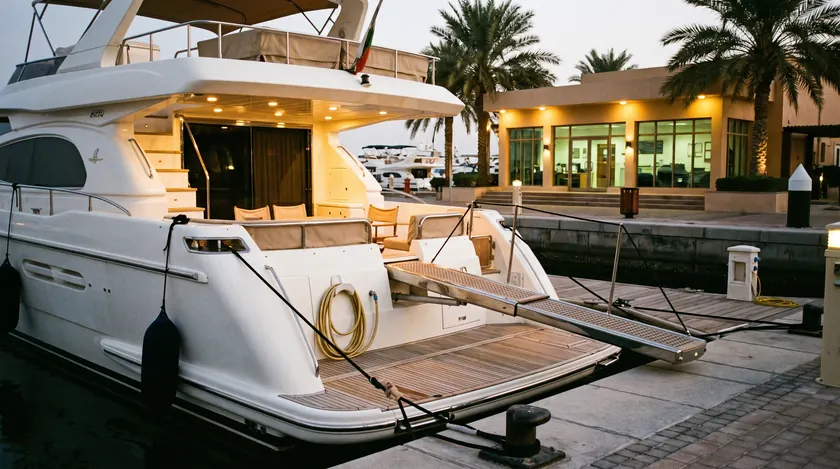
We have cleared yachts through five different Gulf customs desks, and the paperwork looks similar on the surface: a bill of sale, an insurance certificate, a registration application. What actually changes from one GCC country to the next is the tax bill sitting underneath that paperwork, and the difference can run into hundreds of thousands of dollars on a large motor yacht.
This guide sets out what is common across the GCC, the common external tariff, and what is not, VAT or its absence, country by country. Figures below come from ZATCA, Qatar's Ministry of Transport, Oman's MTCIT, Bahrain's Ports and Maritime Affairs and Kuwait's fiscal planning documents as published through 2026.
What is the GCC common external tariff on boats?
Every country in this guide, Saudi Arabia, Qatar, Oman, Bahrain and Kuwait, applies the GCC Common External Tariff of 5 percent to most imported goods, and a yacht is treated as an imported good by default. A separate GCC exemption list covers roughly 600 items, and it is not confirmed whether pleasure yachts sit on that list in any of the five markets.
Our working rule for every client, regardless of destination country, is to budget the 5 percent and have a customs broker confirm the exact HS code before anything is signed. Confirm it with the relevant desk directly: Qatar Customs in Doha, Omani Customs in Muscat, Bahrain Customs in Manama, Kuwait Customs in Kuwait City, or ZATCA in Saudi Arabia. Getting the classification wrong is the single most common way an import budget goes stale between signing and delivery.
Which GCC countries actually charge VAT on a yacht import?
This is where the five markets split hard, and it is the number that actually moves your total landed cost.
| Country | GCC import duty | VAT or tax | Registry authority |
|---|---|---|---|
| Saudi Arabia | 5% (GCC CET) | 15% VAT, on CIF plus duty, ZATCA | MAWANI / SRSA (Red Sea zone) |
| Qatar | 5% (GCC CET) | 0%, no VAT law enacted as of Sept 2026 | Ministry of Transport (MOT) |
| Oman | 5% (GCC CET) | 5% VAT, since April 2021 | MTCIT, Directorate General of Maritime Affairs |
| Bahrain | 5% (GCC CET) | 10% VAT, raised from 5% in Jan 2022 | Ports & Maritime Affairs (PMA) |
| Kuwait | 5% (GCC CET) | 0%, no VAT; luxury excise on yachts proposed, not law | Kuwait Ports Authority (KPA) |
Qatar and Kuwait: zero VAT, for now
Qatar has no VAT as of September 2026. The GCC VAT Framework Agreement sets a future standard rate of 5 percent, and Qatar has done e-invoicing groundwork, but no VAT law has been enacted and no go-live date is confirmed. Do not build a five-year ownership plan on zero VAT staying zero.
Kuwait is similar but with a different pressure sitting behind it. Kuwait has no VAT, and its 2026 to 2030 fiscal plan rules out VAT implementation before 2028 at the earliest, parliamentary opposition has repeatedly blocked it. Instead, Kuwait's government is actively discussing a selective excise tax of 10 to 25 percent on specific luxury categories, tobacco, carbonated drinks, jewellery, luxury cars and explicitly yachts. As of mid-2026 this remains a policy proposal, not legislation. If you are importing into Kuwait on a multi-year horizon, ask your broker for the current status before assuming today's zero-tax position holds.
Do I need a customs broker to import a yacht into Saudi Arabia or Qatar?
In practice, yes, in both markets. Saudi Arabia's ZATCA process calculates VAT on the CIF value plus duty, and getting the CIF valuation and HS classification right is not something we would leave to a first-time importer. Qatar adds its own extra step: Ministry of Transport registration requires a marine-surveyor inspection covering hull, deck access, safety and power-system compliance before it issues a Certificate of Qatar Registry, on top of a QR1,500 registration fee.
A broker earns their fee by knowing which HS code your specific yacht falls under and which documents each authority actually wants first, rather than what a generic checklist says it wants.
Prefer to just ask? Send a short message, we reply the same day.
Ask a questionHow long does yacht registration take in the GCC?
None of the five authorities in this guide publish a fixed turnaround time, and we would be cautious of anyone who quotes one without knowing your specific paperwork. What we can say is how the process differs in shape.
Bahrain's PMA runs registration through a digital platform called Marasi, which has processed registration, licensing, renewals and ownership transfer for more than 25,000 users and 8,000-plus vessels, open to owners of any nationality without a citizenship or residency requirement. That digital-first approach tends to move faster than a process built around an in-person inspection.
Qatar's MOT process includes a physical marine-survey inspection as a mandatory step, which adds a scheduling dependency a purely digital process does not have. Oman's MTCIT runs its registration through a maritime-affairs ePortal, with fees set by tonnage rather than a flat rate. Kuwait's KPA and Saudi Arabia's MAWANI both process applications against documentation rather than a published day count. Build your delivery timeline around your specific authority's process, not a generic GCC average.
Can I keep an offshore-flagged yacht based in the Gulf?
Yes, and it is the norm rather than the exception. In every one of these five markets, a meaningful share of higher-value private yachts stay flagged offshore, commonly Cayman Islands or Marshall Islands, rather than under the local flag, mainly for charter flexibility, resale liquidity and crew-licensing and insurance frameworks that are already internationally established. Local flagging tends to suit yachts permanently based in-country rather than ones that might sell, charter or relocate.
We go through the decision in full, market by market, in our flag registration guide for Gulf owners.
What documents are required to import a used yacht?
The list is broadly consistent across all five countries, with one or two local additions.
- Bill of sale and proof of ownership
- Current insurance certificate
- Deregistration certificate from the previous flag, if reflagging locally
- Marine-survey inspection report, a mandatory step for Qatar's MOT registration specifically
- The destination authority's own application: MAWANI in Saudi Arabia, MOT's Certificate of Qatar Registry, MTCIT's ePortal filing in Oman, PMA's Marasi platform in Bahrain, or KPA's registration in Kuwait
- A customs broker's HS code classification, to settle the duty and VAT calculation before the yacht clears
Where the paperwork ends and the real work starts
Clearing customs and getting a Certificate of Registration is the start of owning a yacht in the Gulf, not the finish line. Local brokers and marina teams handle day-to-day berthing and basic service across all five markets, but heavier refit, engineering and drydock work for larger motor yachts still commonly routes through Dubai specialists such as Albwardy Damen and SYSC, regardless of which of the five flags or registries the yacht ends up under.
Once you know your destination country, check current yacht service contacts in Qatar or yacht service in Oman, or read our full breakdown of what a yacht actually costs to own in Saudi Arabia for the ownership math once the import is done.
Frequently asked questions
What is the GCC common external tariff on boats?
Saudi Arabia, Qatar, Oman, Bahrain and Kuwait all apply the GCC Common External Tariff of 5 percent to most imported goods, yachts included by default. A roughly 600-item GCC exemption list exists, but it is not confirmed whether pleasure yachts are on it, so budget the 5 percent and confirm the HS code with a customs broker.
Which GCC countries charge VAT on a yacht import?
Saudi Arabia charges 15 percent, Bahrain 10 percent and Oman 5 percent. Qatar and Kuwait currently charge no VAT, though Qatar sits inside a GCC framework that sets a future 5 percent rate with no enacted law yet, and Kuwait is discussing a 10 to 25 percent luxury excise that would name yachts specifically, not yet legislated.
Do I need a customs broker to import a yacht into Saudi Arabia or Qatar?
In practice, yes. Saudi Arabia's ZATCA calculates VAT on CIF value plus duty, which depends on getting the HS classification right, and Qatar layers a mandatory marine-survey inspection on top of its Ministry of Transport registration. A broker who knows the specific process saves real time and money on both.
Can I keep an offshore-flagged yacht based in the Gulf?
Yes. Across all five GCC markets in this guide, a significant share of higher-value private yachts stay flagged offshore, typically Cayman Islands or Marshall Islands, for charter flexibility and established crew and insurance frameworks, rather than registering locally.
What documents are required to import a used yacht into the Gulf?
Expect a bill of sale, a current insurance certificate, a deregistration certificate if reflagging locally, and the destination authority's own registration application. Qatar additionally requires a marine-survey inspection report before it will issue a Certificate of Qatar Registry.
Ready to move a yacht into the Gulf
Tell us the yacht, its current flag and your destination country, and we will map the duty, VAT and registration steps specific to that move.
Ask a question